In 1949 two German states came into being, and with them two railways: the Deutsche Bundesbahn (DB) in the West and the Deutsche Reichsbahn (DR) in East Germany, which kept the old name. Both rebuilt their networks and modernized – the DB turned to diesel and electric locomotives early on, while the DR rebuilt steam locomotives for a long time and later received heavy diesel locomotives from the Soviet Union. This page describes Eras III and IV for both railways.
Era III (1949–1970)
| Sub-period | Years | What characterizes this period |
|---|---|---|
| IIIa | 1949–1956 | Founding of the DB; the first newly built steam locomotives; blue F-Zug (premium express) cars and new 26.4 m express cars. On the DR the private railways are nationalized and the rolling stock is renumbered. |
| IIIb | 1956–1970 | Diesel and electric locomotives displace steam; from 1956 only two passenger classes (1st class with a yellow stripe); TEE trains from 1957; chromium oxide green cars; new DB emblem and three-light headlight arrangement. |
Typical on the model: numbers with letters for the type of traction (V = diesel, E = electric, VT = diesel railcar), electric locomotives blue (E 10, E 41) or green (E 40, E 50), diesel locomotives old red, green passenger cars; on the DR the lettering “DR” or “Deutsche Reichsbahn”.
Well-known locomotives and trains of the Bundesbahn
- V 200 (from 1953): the express diesel locomotive of Germany’s postwar boom, already in the Märklin range in the 1950s – Märklin 3021 in the archive.
- V 100 (from 1958): diesel locomotive for branch lines and light trains – Märklin 37176 in the archive.
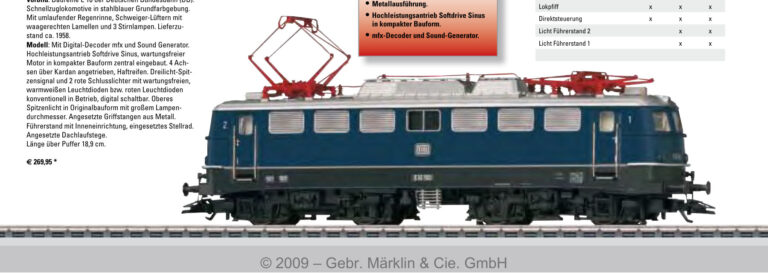
- Standard electric locomotives E 10, E 40, E 41 and E 50 (series production from 1956): one locomotive each for express trains, freight trains, local trains and heavy freight trains – E 10, E 40, E 41, E 50.
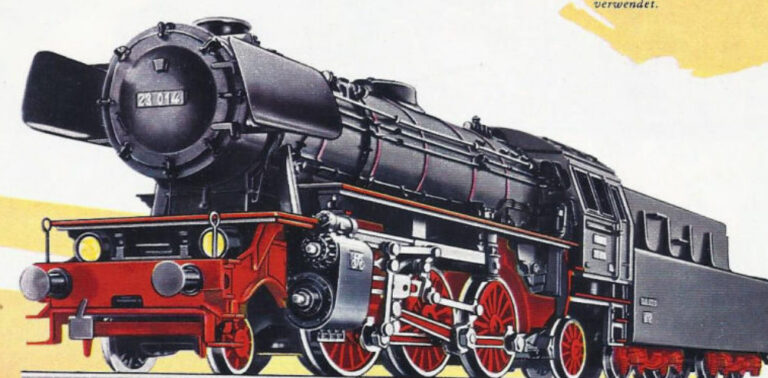
- Class 23 (from 1950): the first newly built steam locomotive of the DB – Märklin 3005 in the archive.
- Class 10 (1957): one of the last new German steam locomotive designs, only two built – Märklin 37085 in the archive.
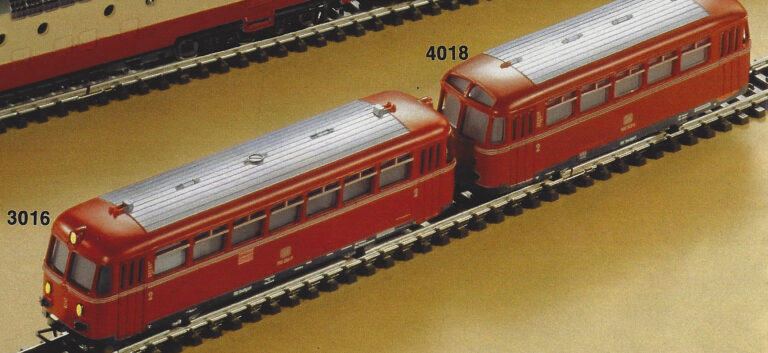
- Railbus VT 95 and VT 98 (from 1950/1955): kept many branch lines alive – Märklin 3016 in the archive.
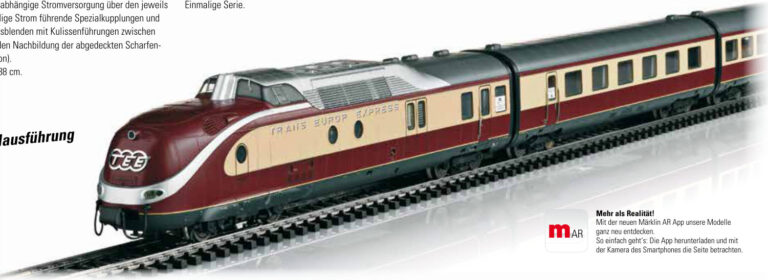
- TEE diesel multiple unit VT 11.5 (from 1957): diesel luxury train for the Trans-Europ-Express – Märklin 37604 in the archive.
- Rheingold (new cars including dome cars from 1962, a TEE from 1965): the most famous German long-distance train.
- E 03 (1965): pre-production version of class 103; at the 1965 transport exhibition in Munich it ran demonstration trips at 200 km/h (124 mph) – Märklin 3053 in the archive.
Well-known locomotives and trains of the Reichsbahn
- Class 01.5 (from 1962): express locomotive with a new boiler, in regular service until the early 1980s – Märklin 39207 in the archive.
- Class 23.10 (from 1955) and 65.10 (from 1954): new steam locomotives of the DR.
- V 180 (from 1963): diesel locomotive for express trains, later class 118.
- E 11 and E 42 (from 1961): electric locomotives from Hennigsdorf, later classes 211 and 242.
- Diesel multiple unit VT 18.16 (from 1963): used, among other services, as the “Vindobona” Berlin–Prague–Vienna – Märklin 38175 in the archive.
Era IV (1965–1990)
| Sub-period | Years | What characterizes this period |
|---|---|---|
| IVa | 1965–1970 | New, computer-readable UIC numbers for locomotives, passenger cars and freight cars – on the DB from 1968, on the DR from 1970. For a long time old and new numbers can be seen side by side. |
| IVb | 1970–1980 | InterCity network from 1971 (at first 1st class only); color trials on cars and locomotives; introduction of ocean blue and beige; steam operation on the DB ends in 1977; heritage railroads appear. |
| IVc | 1980–1990 | “Every hour, every class” with IC ’79; mint turquoise for local services, City-Bahn and City-Express; orient red locomotives on the DB from 1987; on the DR regular steam operation on standard gauge ends in 1988. |
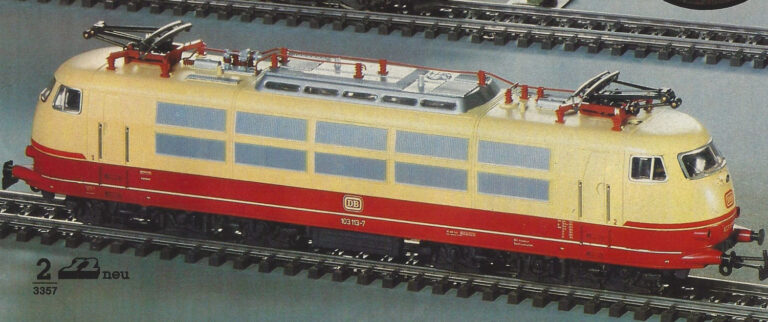
Typical on the model: numbers such as “103 113-7” (the digit after the dash is a check digit), IC cars in ocean blue and beige, “Silberlinge” (stainless-steel commuter cars) in local service, the round DB “cookie” logo, DR locomotives often red or orange with “DR”.
Well-known locomotives and trains of the Bundesbahn
- Class 103 (series production from 1970): the face of the InterCity – Märklin 3357 in the archive.
- Classes 110, 111, 140 and 150: the workhorses for express, local and freight trains – 110, 111, 150.
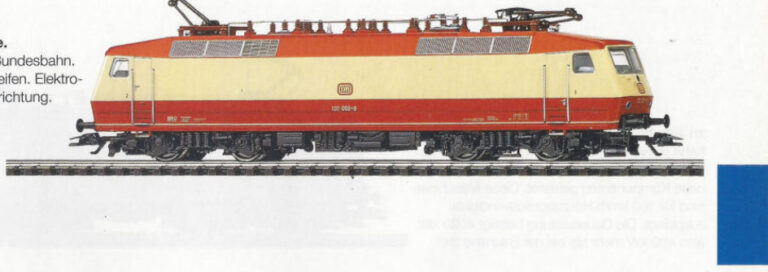
- Class 120 (from 1979): the first three-phase AC electric locomotive in series production and the model for many later locomotives – Märklin 3353 in the archive.
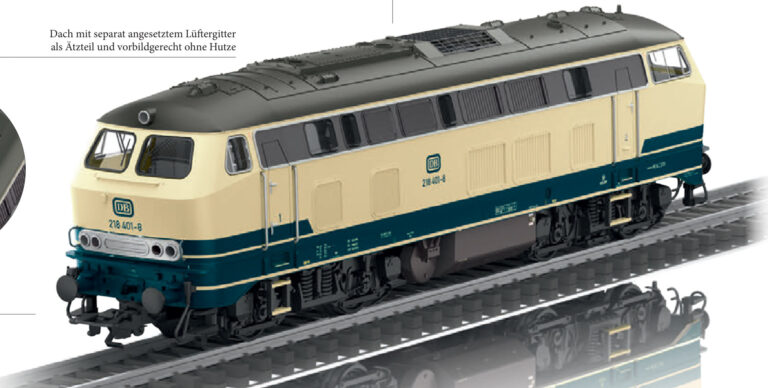
- Class 218 (series production from 1971) and 290: diesel locomotives for line and switching service – 218, 290.
- ET 403 (1973): the “Donald Duck” electric multiple unit for the InterCity, later the Lufthansa Airport Express – Märklin 37779 in the archive.
- TEE Rheingold: ran until 1987.
Well-known locomotives and trains of the Reichsbahn
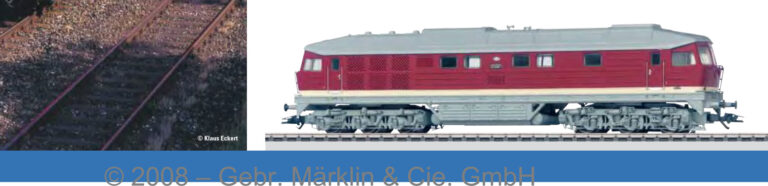
- Class 132 “Ludmilla” (from 1973): heavy diesel locomotive from Luhansk – Märklin 36421 in the archive.
- Class 243 (from 1982): the DR’s most-built electric locomotive, later DB class 143 – Märklin 3443 in the archive.
- Class 250 (from 1974): heavy freight electric locomotive, nicknamed “Container” because of its shape.
- Rebuilt locomotives 50.35 and 52.80 (“Rekoloks”): rebuilt steam locomotives, in service until the end of the steam era.
DB and DR compared
| Bundesbahn (DB) | Reichsbahn (DR) | |
|---|---|---|
| End of steam | 1977 (last run of a steam locomotive in regular service) | 1988 on standard gauge, on narrow-gauge lines to this day |
| New numbers | from 1968 | from 1970 |
| Typical diesel locomotive | V 200, V 100, 218 | V 180, V 100 (DR), 132 “Ludmilla” |
| Typical electric locomotive | E 10, E 41, 103, 111 | E 11, E 42, 243, 250 |
| Long-distance service | TEE, InterCity | Städteexpress (DR intercity trains), international trains heading east |
What happened from 1990: Eras V and VI – Deutsche Bahn AG and the open rail market. The years before: Era II.