With reunification in 1990 the Bundesbahn and the Reichsbahn moved closer together, and in 1994 they were merged into Deutsche Bahn AG. Era V brings the ICE, traffic red and the first private railways. In Era VI many companies then run on the same network – with locomotives that travel across half of Europe.
Era V (1990–2006)
| Sub-period | Years | What characterizes this period |
|---|---|---|
| Va | 1990–1994 | DB and DR work together; locomotives in orient red; car colors by train category (IC, IR, local); the ICE runs from 1991; the first tilting railcars. |
| Vb | 1994–2000 | Rail reform: DB and DR become Deutsche Bahn AG; new logo in a rectangle; traffic red for locomotives and cars; electronic interlockings and new Ks signals. |
| Vc | 2000–2006 | Local service almost exclusively with railcars and push-pull trains; bilevel cars in the metropolitan areas; many tracks and small stations are removed. |
Typical on the model: red DB logo in a rectangle, locomotives and cars in traffic red, the ICE white with a red stripe, bilevel cars in local service, the first private railways with their own colors.
Well-known locomotives and trains
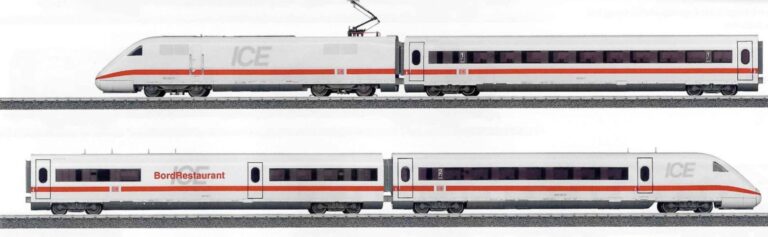
- ICE 1 (from 1991), ICE 2 (from 1996) and ICE 3 (from 2000): high-speed rail in Germany – ICE 2, ICE 3.
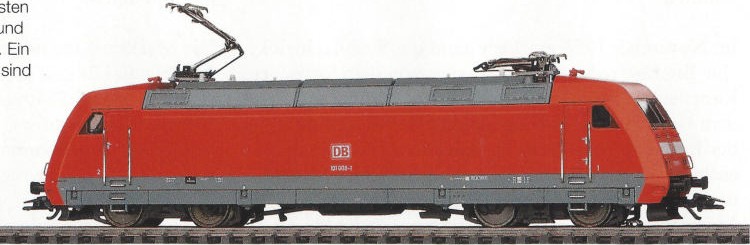
- Class 101 (from 1996): successor to the 103 at the head of InterCity trains – Märklin 37374 in the archive.
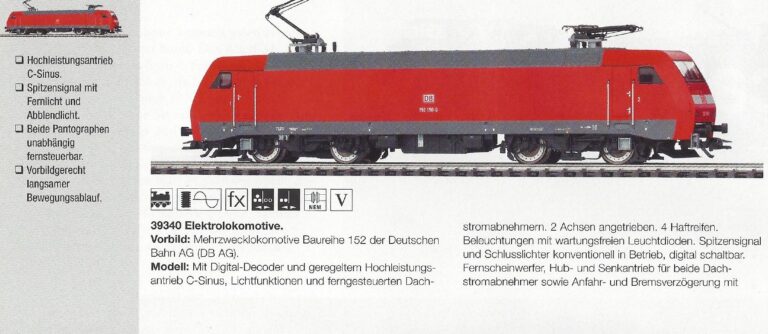
- Class 152 (from 1997) and 185 (from 2000): freight electric locomotives, the 185 also for routes abroad – 152, 185.
- Class 143 (formerly DR 243) and 232 (“Ludmilla”) with the DB logo – 143, 232.
- Tilting diesel multiple units VT 611 and 612 as well as the ICE T.
- Metropolitan (1999): luxury train Hamburg–Cologne.
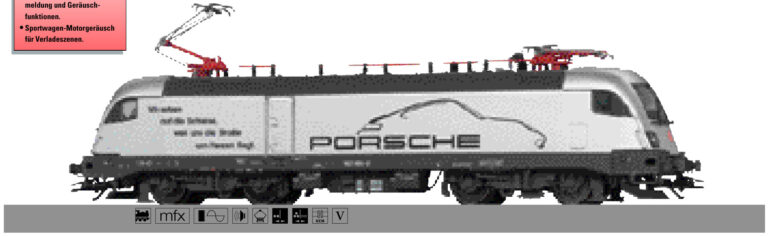
- Taurus: in Austria as 1016/1116 from 2000, on the DB as class 182 from 2001 – Märklin 39835 in the archive.
Era VI (from 2006/2007)
There are no sub-periods for Era VI (yet). Its characteristics:
- Many rail operators run on the same network; there is no longer a uniform color scheme.
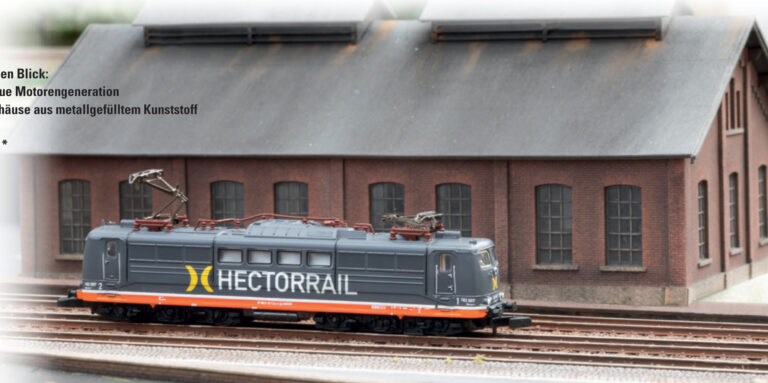
- Leasing companies rent locomotives to changing operators, often in their own paint scheme or with advertising.
- Locomotives now also carry the twelve-digit European vehicle number, plus the keeper’s abbreviation.
- Interlockings are controlled centrally; rural stations become simple stops.
- Freight traffic runs through a few large terminals, and many industrial sidings disappear.
Typical on the model: multi-system locomotives for cross-border traffic, leased and advertising locomotives, local multiple units in the colors of the states and regional transit authorities, digital destination displays.
Well-known locomotives and trains
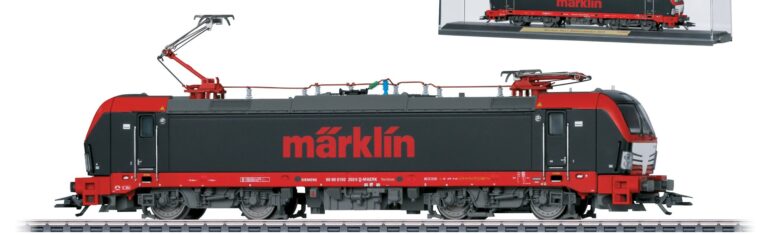
- Siemens Vectron (class 193, from 2010): with many operators all over Europe – Märklin 36161 in the archive.
- Bombardier TRAXX (classes 185.2, 146, 147, 187): the second large locomotive family of our time – Märklin 88486 in the archive.
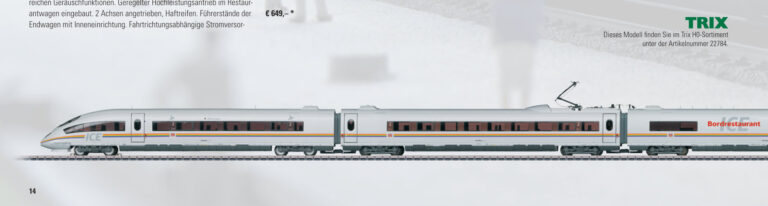
- ICE 4 (from 2017) and ICE 3neo (from 2022): the new ICE generation.
- ÖBB Nightjet (from 2016): night trains across half of Europe.
- FlixTrain (from 2018): private long-distance trains.
- FLIRT, Talent 2 and Mireo: local multiple units used by many operators.
The years before: Eras III and IV. How the neighboring countries define Eras V and VI: Railroad eras in Europe.