Analog, Delta, Digital, fx, mfx or mfx+? And which motor is inside the locomotive? This page puts the control and drive technology of Märklin H0 (called “00 gauge” until the 1950s) in chronological order and explains the entries you find under “Decoder” and “Motor” in our price database.
How control changed
- from 1935Analog
Analog operation with a mechanical reverser
Since the beginning of 00 gauge in 1935, Märklin H0 has run on AC through the center rail. The transformer changes the voltage on the track and with it the speed. To change direction, the transformer sends a short overvoltage pulse. A small electromagnet in the locomotive then pulls in and, via a switching drum, connects the other half of the field coil: the motor runs the other way. A return spring makes sure the reverser does not respond at normal running voltage. The audible click is typical. Very early and simple models had only a hand lever on the locomotive instead of remote reversing.
Until the early 1980s all Märklin AC locomotives ran this way. A locomotive from this period is therefore always “Analog”, even if the catalog does not say so.
ACcenter railreversing pulsefield coil is switchedno address - from 1982Analog electronic
Electronic reversing
In the early 1980s Märklin replaced the relay in the first models with electronics that detect the reversing pulse and switch the direction without contacts. In the 1983 catalog this is noted, for example, for the class 103 (3357); for Märklin 1 (1 gauge) it appeared as early as 1982 on the tank locomotive 5700. The locomotive is still controlled with the transformer as usual; there is no address.
The five-star drive from the 1988/89 catalog (numbers 35xx) belongs to the same family: analog locomotives with a five-pole motor and control electronics, some with adjustable acceleration and braking delay and maximum speed (see Motors).
transformer operationcontactless reversingno address - 1985Märklin Digital
Märklin Digital with the c 80 decoder
On September 13, 1984, Märklin presented its digital system (Motorola format); multi-train operation reached the shops in 1985. Each locomotive gets a decoder with its own address; up to 80 locomotives can be controlled individually from the central unit, later with the Control Unit 6021. The address is set on the decoder with small DIP switches. The c 80 decoder (6080) is built for the Märklin universal motor with field coil and has one switchable locomotive function (“function”, usually the lights), but no load control yet. For locomotives with a DC motor (permanent magnet, e.g. HAMO) there was the c 81 (6081). Around 1989, digital locomotives can be identified in the catalog by their 36xx numbers.
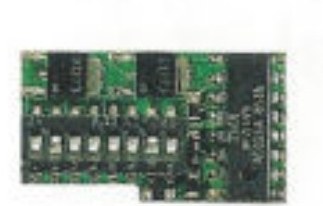
c 80 decoder (6080) 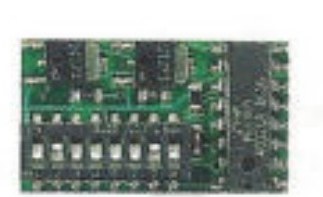
c 81 decoder (6081) Motorola format80 addressesDIP switches1 functionfor universal motor - 1991Digital HLA
Digital with controlled high-efficiency motor (c 90)
The digital drive set 6090 put a five-pole motor with a permanent magnet into the locomotive, controlled by a decoder with load control: the locomotive keeps its speed uphill and downhill, and acceleration and braking delay as well as maximum speed are adjustable. In the 1992 new items several locomotives are already offered with this motor from the factory. From 1993 the decoders also switched functions f1 to f4 in the extended Motorola format, for example for a Telex coupler or a smoke generator. At the end of 1998 the drive set 60901 and the high-efficiency electronics 60902 followed as successors.
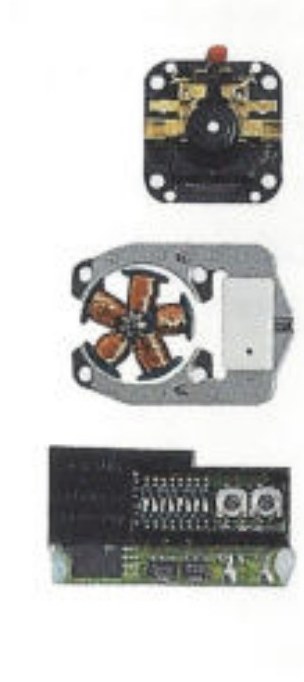
Drive set 60901 (successor to the 6090) 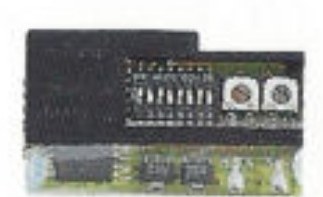
High-efficiency electronics 60902 5-pole motorpermanent magnetload controlf1–f4 (from 1993) - 1992Delta
Delta: the simplified multi-train system
Delta was the low-cost way into multi-train operation; the first locomotives with a factory-installed Delta module appear in the 1992 new items. The Delta module (6603; 66031 with an auxiliary function) works like a simple digital decoder but knows only a few addresses and has no load control. It is built for the standard Märklin motors with field coil (disc or drum commutator). With the Delta Control 6604 four locomotives plus one locomotive without a decoder can run; with the Delta Station 6607 and up to four Delta Mobil 6608 hand controllers, four locomotives at the same time. Delta locomotives also run on Märklin Digital and on a conventional transformer.
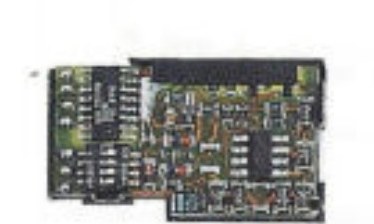
Delta module 6603 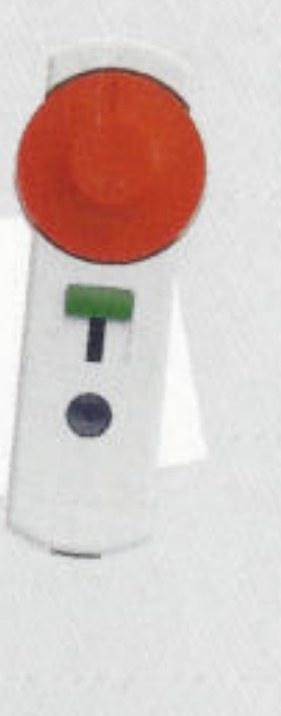
Delta Mobil 6608 4 addressesno load controlfor universal motorcompatible with Digital - 1997fx
fx decoders
The fx decoders are the next generation of Motorola decoders. Besides the locomotive function, the auxiliary functions f1 to f4 can be switched, for example a Telex coupler, smoke or interior lighting. The locomotive is still addressed through a fixed address and runs on all Märklin Digital central units. In the 1999/2000 catalog they can be recognized by the fx symbol.
Motorola formatf1–f4fixed address - 1999Digital C-Sine
Digital with the C-Sine motor
The brushless C-Sine motor went into series production in 1999 with the ICE-S (39710, 1999/2000 catalog). It always needs its own control electronics and is therefore only available with a decoder (see Motors). Later C-Sine locomotives have mfx decoders; the database then shows “mfx” under Decoder and “C-Sine motor” under Motor.
brushlessdecoder only - 2004mfx
mfx: the locomotive registers itself
In 2004 Märklin presented a new generation of equipment under the name “Märklin Systems”: Central Station, Mobile Station and the mfx format. The big difference: nobody has to set an address anymore. When an mfx locomotive is placed on the track, the central unit recognizes it on its own and reads in its name, icon and function buttons. Duplicate addresses no longer occur, and the limit of 80 locomotives is gone. The decoders switch far more functions, also run on a transformer and can still be used on older digital layouts through a Motorola address. Many newer mfx decoders also support DCC.
How the catalog shows mfx automatic registrationfeedbackmany functionsbackward compatible - 2013mfx+
mfx+: the play world
mfx+ has existed since 2013. The locomotive brings a small operating simulation with it: the screen of the Central Station shows a cab, and during the run supplies such as coal, water, diesel or sand are used up and have to be refilled. This works with the Central Station 60213 or 60215 (current software) and with the Central Station 3. On any other central unit an mfx+ locomotive behaves like an ordinary mfx locomotive.

Symbol line from the 2020 new items brochure: the “mfx” in a frame stands for mfx+, next to it DCC and sound suppliescabCentral Station
Delta and Digital compared
The three basic set-ups for multi-train operation differ as follows (as of around 1999/2000):
| Feature | Delta with Control 6604 | Delta with Station 6607 | Märklin Digital |
|---|---|---|---|
| Central unit | Delta Control 6604 | Delta Station 6607 | Control Unit 6021 |
| Locomotives at the same time | four with Delta module and one without | four | up to 80 |
| Switchable locomotive functions | running only | lights and one auxiliary function | lights and up to four auxiliary functions |
| Turnouts and signals | not controllable | not controllable | up to 256 |
| Gauges | H0 | H0 and 1 | H0 and 1 |
| Controllers | one Delta Pilot 6605 | up to four Delta Mobil 6608 | Control 80 f, supplemented by Keyboard, Memory and Interface |
How motors changed
- from 1935Universal motor
The principle: universal motor with field coil
The classic Märklin motor is a series-wound motor: the magnetic field does not come from a permanent magnet but from a field coil connected in series with the armature. That is why it runs on AC as well as DC (“universal”). The field coil has two halves, one for each direction; the reverser connects one of them to ground at a time. The armature has three poles. Robust and long-lasting, but comparatively loud and jerky at low speed. The well-known postwar designs are the motor with a disc commutator (from 1953) and the one with a drum commutator (from 1973).
Before the war there were also locomotives in 0 gauge and 1 gauge with a clockwork drive (wound up with a key), live steam locomotives with a small steam engine, and 4-volt low-voltage locomotives with a permanent-magnet motor whose direction is changed by a reversing switch.
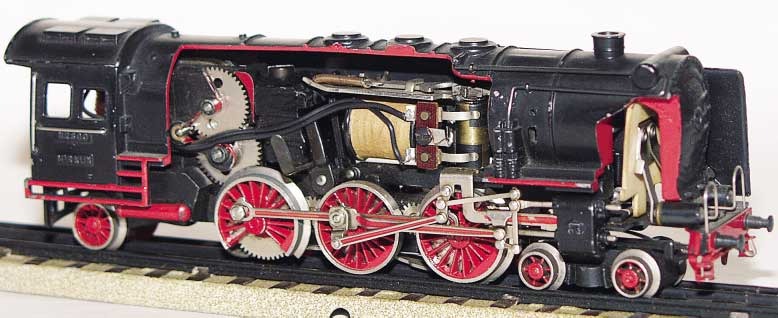
Cutaway model of a Märklin steam locomotive of the 1930s from the Märklin archive: the universal motor with field coil and three-pole armature sits crosswise in the boiler. Photo: Märklin Insider 3/2003 field coil3-pole armatureAC and DC - from 1953Disc commutator
Universal motor with a disc commutator
On the older Märklin motors the commutator is a flat disc on the end face of the armature, and the brushes press on it from the front. There is a small version (SFCM, from 1953, e.g. in the class 89, class 80 and E 10) and a large one (LFCM, from 1957 with the V 200, later e.g. in the E 44, class 212, class 216 and class 81). From 1973 new models got the drum commutator; older designs with a disc commutator were still built until about 1982. For both sizes Märklin offers retrofit sets for conversion to a five-pole motor with a permanent magnet.
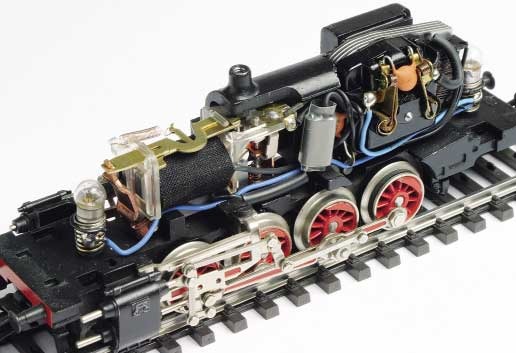
Steam locomotive chassis: disc commutator motor with field coil, in front of it the mechanical reverser. 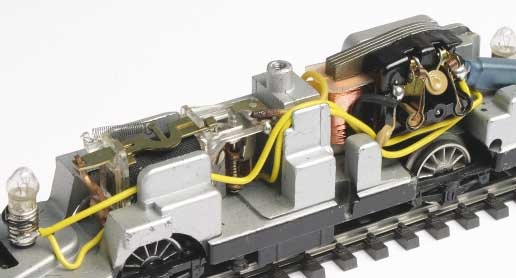
Electric locomotive chassis: field coil with copper winding, on the end face the brush plate on the flat commutator. Photos: Märklin Insider 3/2003 flat commutatorsmall and largefield coil - from 1966HAMO
HAMO: DC for two-rail track
From 1966 Märklin offered the HAMO models for two-rail DC (numbers 83xx, mostly DC versions of the 30xx locomotives). Instead of the field coil the motor has a permanent magnet; the direction changes when the polarity of the track voltage is reversed. These locomotives do not run on Märklin center-rail track.
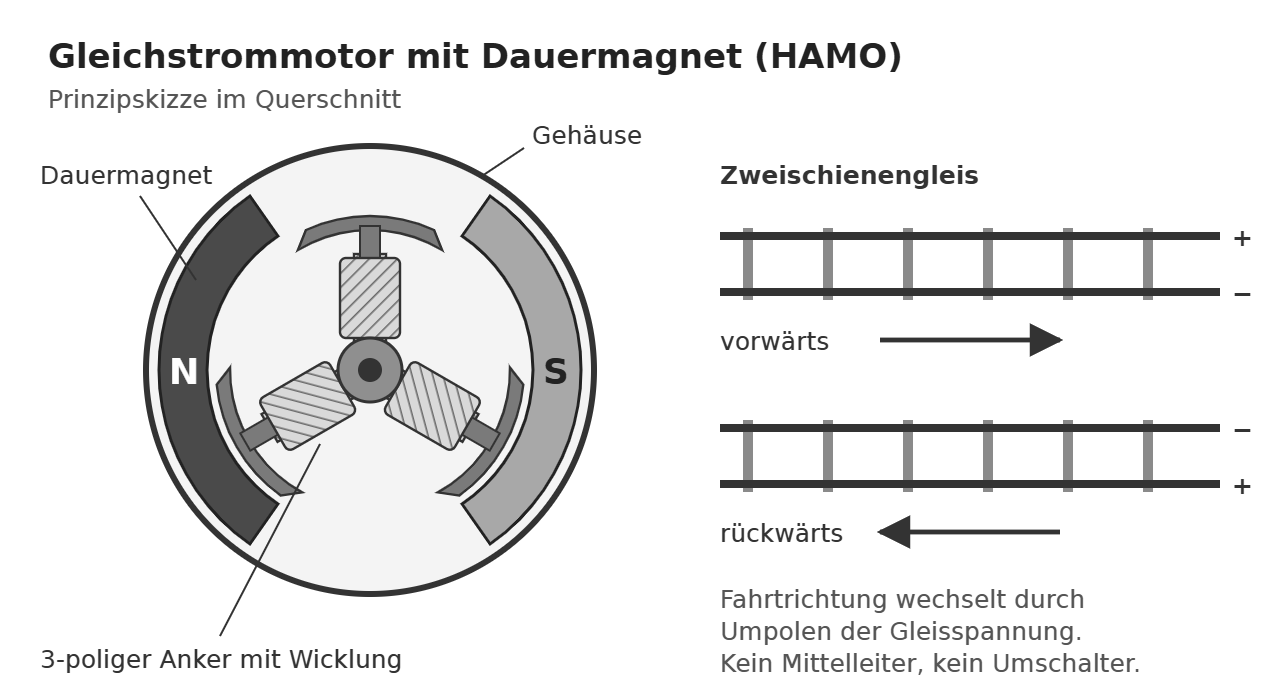
Schematic: in the HAMO motor two permanent magnets create the field. The direction changes when the voltage on the two-rail track is reversed. Our own drawing permanent magnetDCtwo-rail track - from 1973Drum commutator
Universal motor with a drum commutator
Around 1973 the drum commutator motor (DCM) arrived, first in the class 003 (3085). Here the commutator segments sit around a drum-shaped extension of the armature, and two carbon brushes rub against it from the side. The principle with field coil and three-pole armature stayed the same. The drum commutator gradually replaced the disc commutator. The Delta module and the c 80 decoder are built for both commutator types.
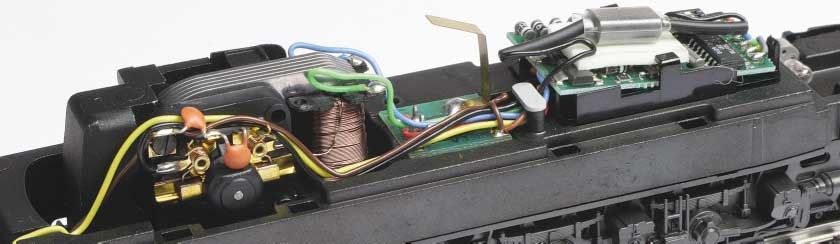
Drum commutator motor in a locomotive chassis, here with the additional electronics for the electromechanical reverser fitted from 1982. Photo: Märklin Insider 3/2003 2 carbon brushes3-pole armaturefield coil - 1988Five-star
Five-star drive
The five-star drive came with the 1988/89 catalog: a five-pole motor with control electronics in analog locomotives (numbers 35xx), depending on the model with adjustable acceleration and braking delay and maximum speed. With the retrofit kit 7180, model railroad shops could convert older locomotives with a drum commutator motor to this technology. The digital versions of these models had the numbers 36xx.
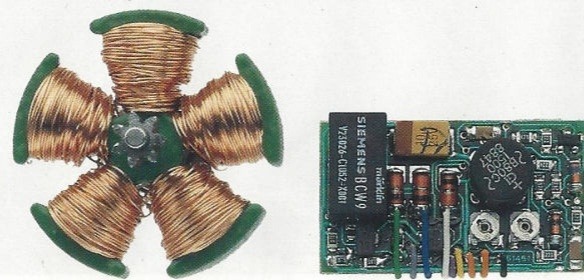
The heart of the five-star drive: five-pole armature (left) and control electronics with the adjustment potentiometers (right). Illustration: Märklin catalog 1989/90 5-pole motorcontrol electronicsanalog - from 1989Coreless
Coreless (bell-armature) and Faulhaber motor
In a coreless motor only a light, iron-free winding shaped like a bell turns around a fixed magnet. It draws little current, runs especially quietly and smoothly, and because of its low mass it coasts for a long time. In H0 it first appeared in top models, for example as two synchronized Faulhaber motors in the ICE 3671 (1989 catalog), later in 37550 among others. In Z gauge (mini-club) it succeeded the earlier motors (three-pole at first, five-pole from 2000) and is found in many models today.
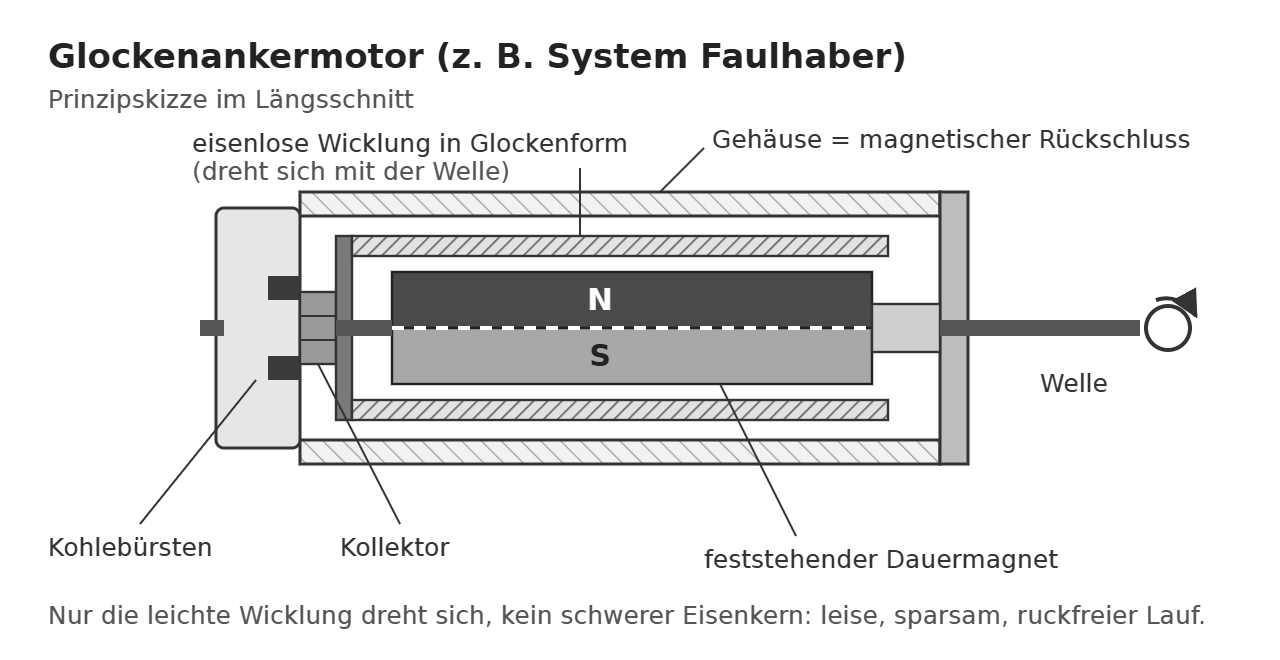
Schematic: in the coreless motor only the iron-free winding turns around the fixed magnet. Our own drawing iron-free armaturequietlong coasting - 1991High-efficiency motor
5-pole high-efficiency motor
The high-efficiency motor replaces the field coil with a permanent magnet and the three-pole armature with a five-pole one. A DC motor like this can only run on AC track with electronics, so it always comes with a decoder. The five-pole armature gives smoother running at low speed, more torque and better acceleration; together with load control the locomotive runs quietly and very evenly. Märklin’s retrofit sets contain exactly these parts (permanent magnet and five-pole armature). In today’s catalogs it is called “Controlled high-efficiency motor”, often with a flywheel.
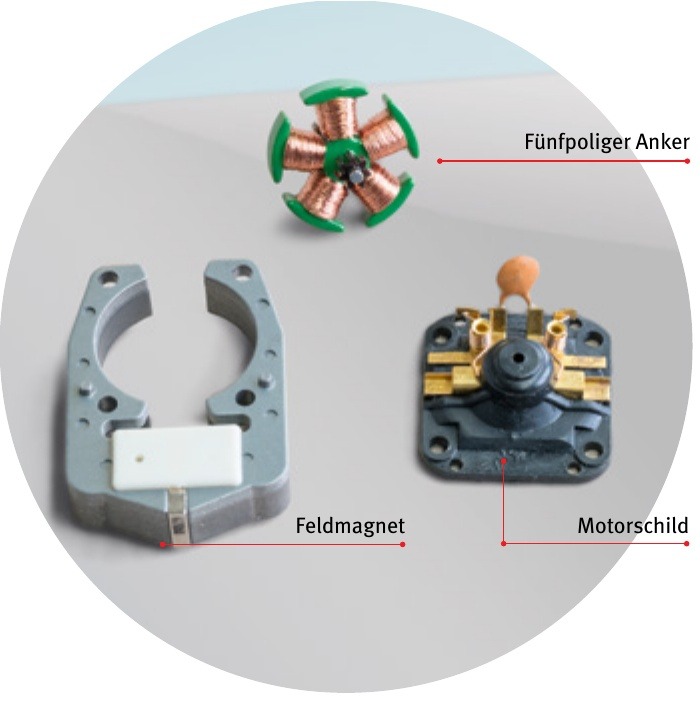
The parts of the high-efficiency motor: five-pole armature, permanent magnet (field magnet) and motor shield with the carbon brushes. Photo: Märklin Magazin 3/2016 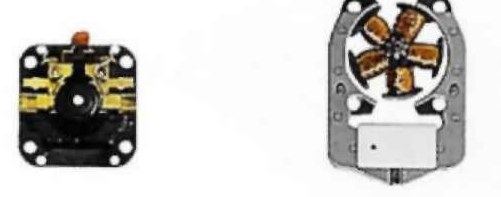
60941: for locomotives with a drum commutator motor 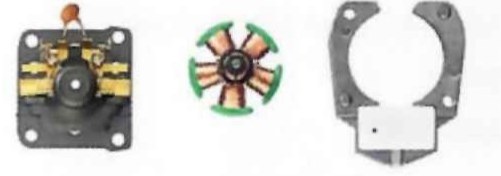
60943: for the small disc commutator motor 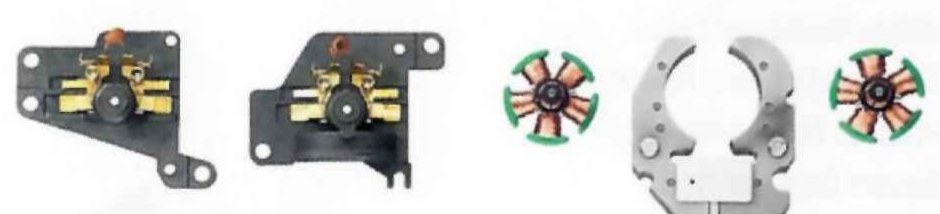
60944: for the large disc commutator motor permanent magnet5-pole armaturedecoder only - 1999Sine
C-Sine and Softdrive Sine
The C-Sine motor is a brushless motor: instead of a commutator with carbon brushes, its own electronics create a rotating field, while sensors report the position of the rotor. It runs powerfully and evenly even at the lowest speed, draws little current and is almost wear-free. The drawback: it hardly brakes by itself, so a locomotive without power can roll away on a gradient. The first model was the ICE-S in 1999. A more compact version came later as Softdrive Sine. The motor can only be operated and replaced together with the matching original electronics.
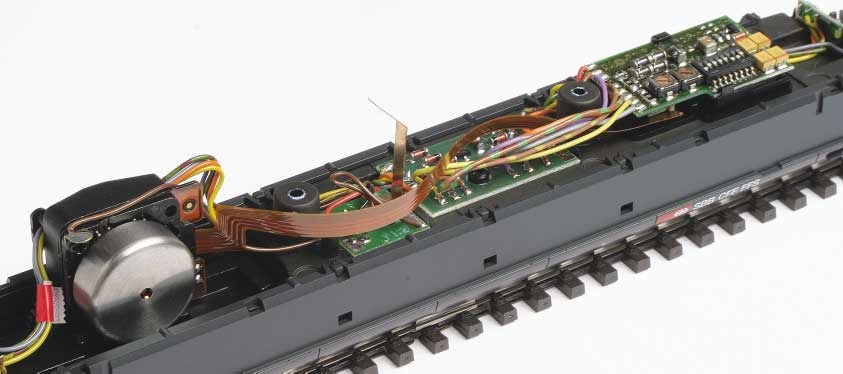
The first C-Sine motor: in the ICE-S of 1999, with its own control electronics and sensors for the rotor position. Photo: Märklin Insider 3/2003 brushlesselectronics onlylow wear - todayCatalog terms
The terms in current catalogs
Newer catalogs mainly use these terms: “Controlled high-efficiency motor with flywheel” for large locomotives, “Special motor” or “Miniature motor” for small locomotives and railcars, “Coreless (bell-armature) motor” for many Z gauge models. In our database the Motor field always shows the term from the catalog for that item.
Which motor is inside?
| Motor | Magnetic field | Armature | Commutator | Operation |
|---|---|---|---|---|
| Disc commutator (small/large) | field coil | 3-pole | flat disc | analog, Delta, c 80 |
| Drum commutator | field coil | 3-pole | drum, 2 carbon brushes | analog, Delta, c 80 |
| HAMO | permanent magnet | 3-pole | like the Märklin motor | DC, two-rail track |
| Five-star / high-efficiency motor | permanent magnet | 5-pole | drum, 5 segments | electronics only |
| Coreless / Faulhaber | permanent magnet inside | iron-free | precious-metal brushes | with decoder or on DC |
| C-Sine / Softdrive Sine | permanent magnets in the rotor | none | none | only with its own electronics |
What runs with what?
| Locomotive equipment | Transformer (analog) | Delta | Control Unit 6021 | Central Station |
|---|---|---|---|---|
| Analog (mechanical or electronic, including five-star) | yes | Control 6604 only (as the “+1”) | no | no |
| Delta module | yes | yes | yes | yes (Motorola) |
| Digital c 80 / c 90 / fx | yes | yes, with a matching address | yes | yes (Motorola) |
| mfx | yes | possible, via a Motorola address | yes, via a Motorola address | yes, all functions |
| mfx+ | yes | possible, via a Motorola address | yes, via a Motorola address | yes, play world with CS 60213/60215 or CS3 |
Locomotives without a decoder do not belong on a digital layout: full voltage is always on the track there, so the motor hums and gets warm. HAMO DC locomotives never belong on Märklin center-rail track.
Entries in our database
- Decoder: Analog
- AC without digital technology, mechanical reverser (relay) or manual switch
- Decoder: Analog, electronic reversing
- AC without an address, electronic reversing; this also includes the five-star drive
- Decoder: DC analog
- HAMO two-rail DC and the prewar 4-volt low-voltage system
- Decoder: Delta
- Delta module, few addresses, no load control
- Decoder: Digital
- Motorola decoder (c 80 and successors), fixed address
- Decoder: Digital with high-efficiency motor
- Motorola decoder with load control and five-pole high-efficiency motor (c 90 / 6090)
- Decoder: fx
- Motorola decoder with functions f1–f4
- Decoder: Digital with C-Sine motor
- Decoder with C-Sine control (before mfx)
- Decoder: mfx
- registers itself, many functions
- Decoder: mfx+
- mfx with play world (supplies, cab)
- Motor
- taken from the catalog, e.g. “Controlled high-efficiency motor with flywheel”, “Special motor”, “Coreless (bell-armature) motor”, “Five-star drive”
- Motor on older locomotives
- “Universal motor” for Märklin AC locomotives up to the early 1980s and for Delta locomotives, “DC motor” for HAMO and low-voltage locomotives, “Clockwork” and “Live steam” for the prewar trains
If nothing is shown for an item, the equipment is not reliably documented. In that case we deliberately leave the field empty instead of guessing. For starter sets and cars the field stays empty, and so does the decoder for Z gauge (mini-club).
Illustrations: Märklin catalogs 1999/2000 and 2020/2021, 2020 new items. Information based on Märklin catalogs and new items brochures.