Railroad eras in Europe: Switzerland, Austria, France & more
For decades Märklin has built models of many European railways, especially from Switzerland, Austria, France, the Benelux countries and Scandinavia. The six main eras apply everywhere. But because every country has its own railroad history, MOROP sets separate dates and sub-periods for most countries. On this page each country has its own section – with the dates, the most important characteristics and well-known locomotives.
“–” means: this era is not (yet) defined in the recommendation for that country. Luxembourg, Sweden and Norway have no classification of their own; the general boundaries of NEM 800 apply there.
Switzerland (SBB and private railways)
Until 1902 private companies such as the Gotthard Railway, the Nordostbahn and the Centralbahn build and operate the network. In 1902 the Swiss Federal Railways (SBB) are founded.
Switzerland electrified its main lines as early as the 1920s – earlier and more completely than almost any other country.
Alongside the SBB there are still many private and narrow-gauge railways today, such as the BLS, the Rhaetian Railway (RhB) and the Matterhorn Gotthard Bahn (MGB).
Era
Sub-periods and characteristics
I
a/b 1844–1882: first lines, narrow gauge too from 1874 · c 1882–1902: Gotthard Railway, bogie cars · d 1902–1920: founding of the SBB, heyday of steam, first electric lines
II
a 1920–1928: main lines electric, electric locomotives brown · b 1928–1937: more lines under catenary, electric locomotives green from 1928 · c 1937–1945: light high-speed railcars; in 1944 the BLS Ae 4/4 as the first powerful electric locomotive on bogies
III
a 1945–1956: lightweight steel cars in series production · b 1956–1970: only two passenger classes, standard cars from 1958, freight cars red-brown
IV
a 1970–1980: UIC numbers on passenger cars, the “Swiss Express” in 1975 · b 1980–1990: standard cars IV, red electric locomotives from 1984
V
a 1990–2000: new locomotive numbers, Zurich S-Bahn with bilevel trains · b 2000–2005: open network access, ICN tilting train, bilevel IC
VI
from 2005: the new Mattstetten–Rothrist line, Lötschberg Base Tunnel (2007) with cab signaling
Well-known locomotives and trains
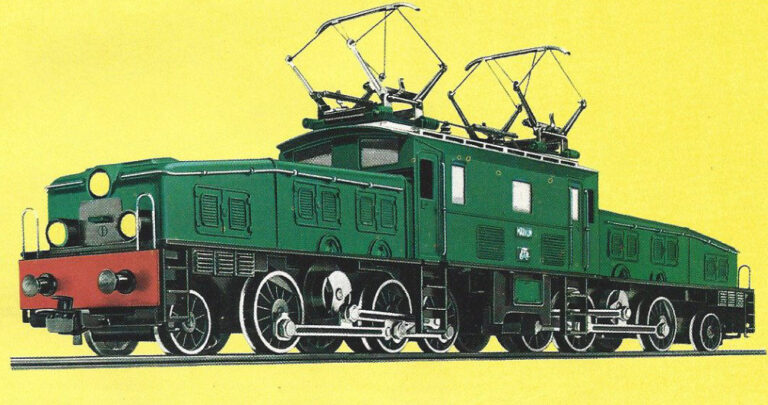
“Crocodile” Ce 6/8 II (from 1919): freight locomotive on the Gotthard line and a Märklin classic for decades – Märklin 3015 in the archive.
Ae 3/6 (from 1921) and Ae 4/7 (from 1927): express locomotives of the first electrification – Ae 3/6.
“Landi-Lok” Ae 8/14 11852 (1939): double locomotive shown at the Swiss national exhibition – Märklin 55816 in the archive.
Glacier Express (since 1930): panorama train of the narrow-gauge railways from Zermatt to St. Moritz.
Giruno (from 2019): high-speed train through the Gotthard Base Tunnel.
Märklin 3015: “Crocodile” Ce 6/8 of the SBB, H0, 1973 new items
Austria (kkStB, BBÖ, ÖBB)
Until 1918 the Imperial Royal Austrian State Railways (kkStB) and large private railways such as the Südbahn operate.
From 1923 the Austrian Federal Railways (BBÖ) run operations. In 1938 the network is incorporated into the Deutsche Reichsbahn.
After 1945 independent Austrian railways are formed again, the Austrian Federal Railways (ÖBB).
Era
Sub-periods and characteristics
I
a 1837–1858: first lines · b/c 1858–1884: private railways grow into a network · d 1884–1891: the kkStB builds main and local lines · e 1891–1913: nationalization (except the Südbahn), superheated steam, vacuum brake · f 1913–1920: first electric line
II
a 1920–1928: transition to the Federal Railways · b 1928–1938: further expansion of electric operation · c 1938–1945: part of the Deutsche Reichsbahn
III
a 1945–1952: reconstruction · b 1952–1956: new markings from 1953 · c 1956–1970: no more 3rd class, new rolling stock in large numbers
IV
a 1970–1975: many new locomotives and railcars · b 1975–1980: first colorful paint schemes · c 1980–1990: UIC numbers on freight cars, farewell to green
V
a 1990–2000: bilevel cars, advertising paint schemes · b 2000–2005: new long-distance cars, semaphore signals disappear
VI
from 2005: farewell to the postwar rolling stock, Talent railcars, Railjet, new numbers with country and keeper codes
Well-known locomotives and trains
kkStB 310 (from 1911): one of the most elegant express steam locomotives in Europe.
“Blue Lightning” 5045 (from 1936): diesel railcar for fast services.
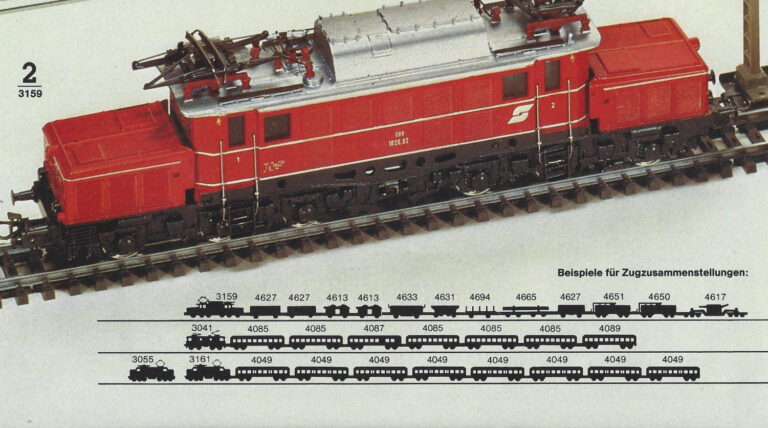
Märklin 3159: class 1020 of the ÖBB, H0, 1982 new items
France (large companies, SNCF)
Until 1937 large companies with their own colors operate the network: Nord, Est, PLM, PO, Midi and the state railway État.
In 1938 they are merged into the SNCF.
France turned to 25,000-volt AC early on and has run the TGV since 1981.
Era
Sub-periods and characteristics
I
a 1832–1870: the network is built · b 1871–1918: steam locomotives in their final form, founding of the sleeping car company CIWL, branch lines · c 1918–1925: wartime and US locomotives in service
II
a 1926–1933: all-steel cars, electric lines in the south · b 1934–1937: more railcars, new signaling system · c 1938–1945: founding of the SNCF, the old colors remain at first
III
a 1946–1949: wartime locomotives, old colors still visible · b 1950–1955: uniform numbers, start of 25 kV, stainless steel cars · c 1956–1960: no more 3rd class, TEE · d 1961–1970: new numbering system, cars become green and gray
IV
a 1971–1979: end of steam, Corail cars · b 1980–1990: TGV on the new Paris–Lyon line
V
a 1991–1995: TGV Atlantique and Channel Tunnel, regional trains as TER · b/c 1996–2004: colors by business unit, TER run by the regions
VI
from 2004: other railways on the network, new SNCF logo
Well-known locomotives and trains
“Le Train Bleu” (from 1922): luxury train from Calais to the Côte d’Azur.
141 R “Mikado” (from 1945): more than 1,300 steam locomotives from North America for the reconstruction – Märklin 38141 in the archive.
CC 7100 and BB 9000: world record of 331 km/h (206 mph) in 1955.
“Mistral” (from 1950): express train Paris–Nice.
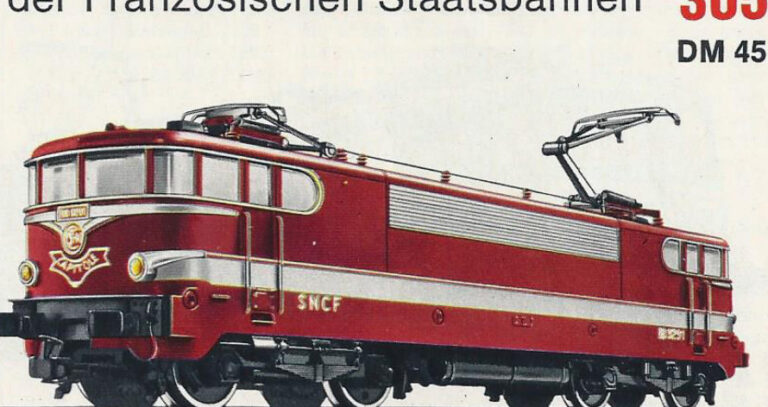
BB 9200 (from 1957): with “Le Capitole” Paris–Toulouse from 1967, France’s first scheduled 200 km/h (124 mph) train – Märklin 3059 in the archive.
CC 6500 (from 1969), TGV Sud-Est (from 1981), Eurostar (from 1994) and Thalys (from 1996).
Märklin 3059: BB 9200 “Le Capitole” of the SNCF, H0, 1969 new items
Italy (FS, Trenitalia)
In 1905 the state railway Ferrovie dello Stato (FS) is founded.
Northern Italy long had three-phase AC operation with two overhead wires; later 3,000-volt DC prevailed.
Typical colors are chestnut brown and isabella (a light beige), and gray and blue from the 1970s.
Era
Sub-periods and characteristics
I
a 1839–1865 · b 1865–1885: five large companies · c 1885–1905: three networks, first electric trials · d 1905–1922: founding of the FS, three-phase electrification
II
a 1922–1931: steel cars, 3,000-volt DC from 1928 · b 1931–1943: brown and isabella as the standard colors · c 1943–1949: divided network, reconstruction
III
a 1949–1956: chestnut brown and isabella · b 1956–1968: no more 3rd class, slate gray cars, FS logo
IV
a 1968–1980: end of steam and three-phase operation, gray and blue locomotives · b 1980–1989: locomotives with power electronics, FS diamond logo, end of the TEE in 1988
V
a 1989–2001: FS becomes a joint-stock company, split into Trenitalia and RFI · b 2001–2009: private freight railways
VI
from 2010: competition in passenger service, for example from Italo
Well-known locomotives and trains
Steam locomotive 685 (from 1912): a typical FS express locomotive.
E 428 (from 1934): large express electric locomotive.
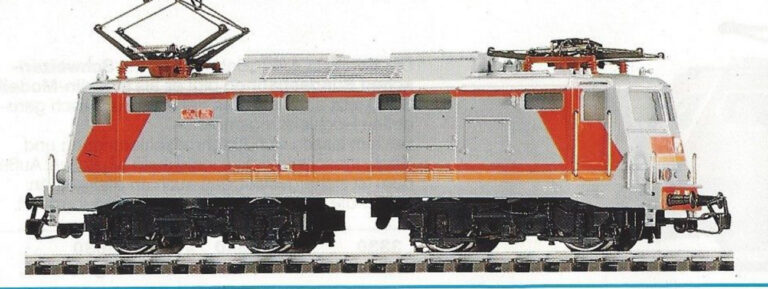
E 424 (from 1943): versatile electric locomotive for passenger and freight trains, in service for more than 50 years – Märklin 3162 in the archive.
“Settebello” ETR 300 (from 1953): luxury electric multiple unit Milan–Rome with an observation compartment.
E 444 “Tartaruga” (from 1967): Italy’s first 200 km/h (124 mph) electric locomotive.
Private companies such as the HSM and the Staatsspoorwegen (SS) build the network. In 1938 they become the NS (Nederlandse Spoorwegen).
The main lines are electrified early, and steam ends as early as 1958.
From the 1970s the yellow NS design defines the look of the railway.
Era
Sub-periods and characteristics
I
a 1839–1890: many companies, colorful liveries · b 1890–1917: first electric line · c/d 1917–1925: cooperation of HSM and SS, dark green standard color
II
a 1925–1934: electric multiple units · b 1934–1939: streamlined railcars, founding of the NS in 1938 · c 1939–1947: war and reconstruction
III
a 1947–1953: all main lines electric, turquoise rolling stock · b 1953–1958: new colors, TEE from 1957, end of steam · c 1958–1968: multiple units replace older rolling stock, UIC numbers
IV
a 1968–1978: new NS design, yellow and gray locomotives, yellow and blue Intercity trains · b 1978–1989: modernization, new safety systems
V
a 1989–2000: split into passenger and freight operations · b 2001–2005: private railways, VIRM bilevel trains
VI
from 2005: the Betuweroute freight line and the high-speed line
Well-known locomotives and trains
Electric locomotive series 1200 (from 1951): a powerful locomotive with American technology – Märklin 3051 in the archive.
“Hondekop” multiple units Mat ’54 (from 1954): called “dog’s head” because of their shape.
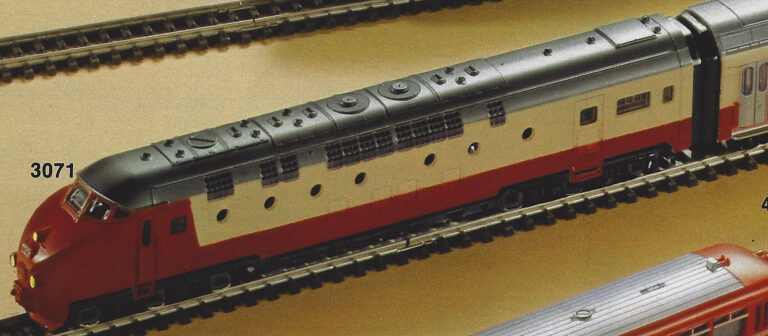
TEE “Edelweiss” (from 1957): diesel multiple unit of the NS and SBB from Amsterdam to Zurich – Märklin 3071 in the archive.
Koploper ICM (from 1977): Intercity multiple unit with a gangway door in the cab front.
Märklin 3071: TEE “Edelweiss” of the NS/SBB, H0, 1979 catalog
Belgium (SNCB/NMBS)
In 1835 one of the first passenger trains on the European mainland ran between Brussels and Mechelen – half a year before the Ludwig Railway Nuremberg–Fürth.
The state took over many private railways early on; in 1926 the national railway company SNCB/NMBS was founded.
Era
Sub-periods and characteristics
I
until 1925: first lines modeled on English practice; important inventions such as the Belpaire firebox come from Belgium; the CIWL is founded in Brussels in 1872
II
1925–1945: first electric line in 1935 (Brussels–Antwerp), “B” logo from 1936
III
1945–1970: steam ends in 1966, TEE from 1957, UIC numbers
IV
1970–1990: new locomotive numbers in 1971, burgundy cars
V
from 1990: Eurostar, Thalys, new high-speed lines
Well-known locomotives and trains
Streamlined steam locomotive type 12 (1939): for fast trains Brussels–Ostend.
Electric locomotive series 16 (1966): multi-system locomotive for trains to Germany and France.
HLE 27 (from 1981) and HLE 13 (from 1997).
Benelux train Amsterdam–Brussels and Thalys.
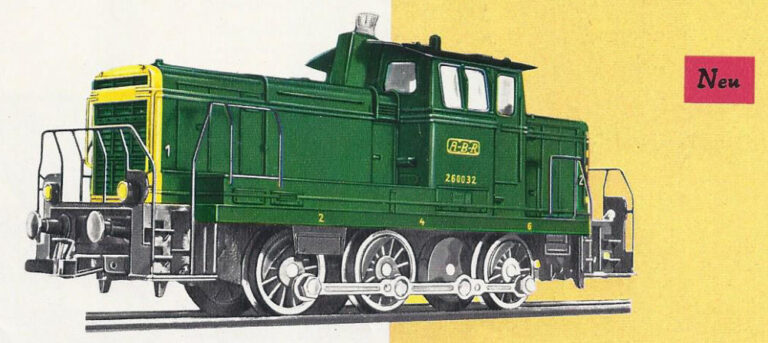
Märklin 3069: diesel locomotive 260.032 of the SNCB, H0, 1963 new items
Luxembourg (CFL)
Until 1946 several companies operate the network, among them the Wilhelm-Luxemburg-Bahn and the Prinz-Heinrich-Bahn. In 1946 the state-owned CFL (Société Nationale des Chemins de Fer Luxembourgeois) is founded. There is no separate MOROP classification; the general era boundaries apply.
Well-known locomotives and trains
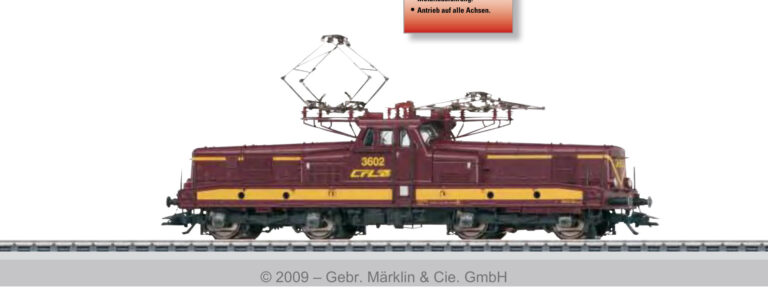
Series 3600 (from 1958): electric locomotives closely related to the French BB 12000 – Märklin 37334 in the archive.
Märklin 37334: series 3600 of the CFL, H0, 2009 new items
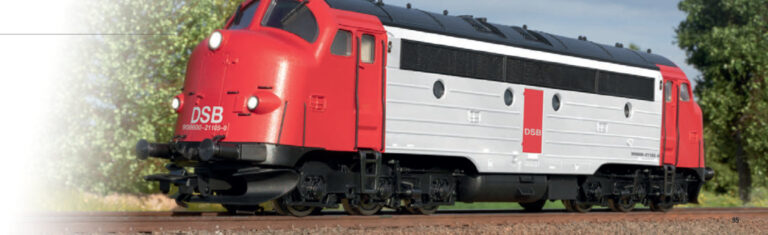
Denmark (DSB)
The state railway DSB is founded in 1892. Ferries and large bridges connect the islands.
From 1935 the fast “Lyntog” multiple units dominate long-distance service.
Electrification comes late – only from the 1980s.
Era
Sub-periods and characteristics
I
1847–1920
II
1920–1941: Lyntog from 1935, Little Belt and Storstrøm bridges
III
1941–1969: wine red cars, large diesel locomotives
IV
1969–1990: red and black locomotives, Intercity
V
1990–2006: IC3, links across the Great Belt (1997) and the Øresund (2000)
ME (from 1981): diesel locomotive for express and commuter trains.
IC3 (from 1989/1990): diesel multiple unit with a rubber bumper on the front.
Märklin 39630: MY of the DSB, H0, 2023 new items
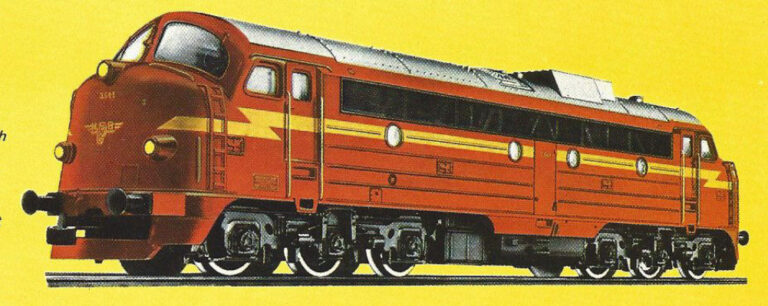
Sweden (SJ) and Norway (NSB)
Neither country has its own MOROP classification; the general boundaries apply. Sweden: the state railway SJ is founded in 1856; from 1915 electric trains run on the ore line in the north. Norway: the state railway NSB is founded in 1883 (Vy since 2019); the Bergen Line opens in 1909.
Well-known locomotives and trains
Sweden: Rc electric locomotives (from 1967), the standard locomotive of the SJ – Märklin 39281 in the archive; tilting train X2000 (from 1990).
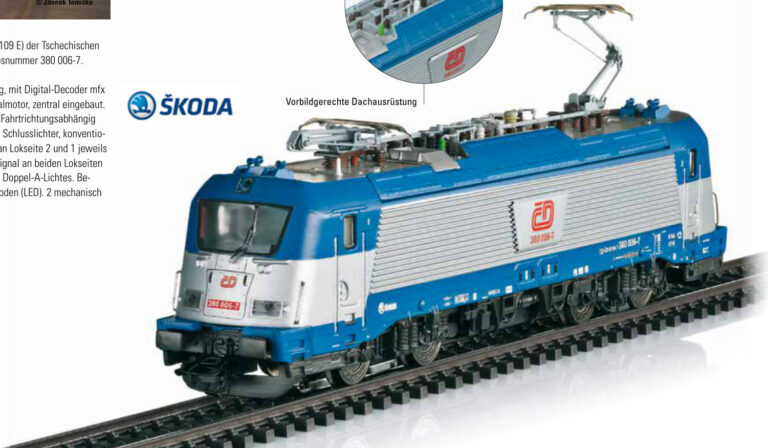
Märklin 36203: class 380 of the ČD, H0, 2018 new items
Poland (PKP)
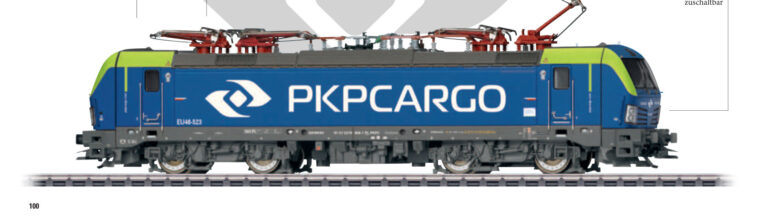
After 1918 one Polish railway is formed from the railways of the three partitioning powers; the PKP (Polskie Koleje Państwowe) is founded in 1926. After 1945 much is still steam-hauled; from the 1960s electrification proceeds rapidly. In 2001 the PKP is converted into a joint-stock company with several subsidiaries.
Era
Sub-periods and characteristics
I
1842–1918
II
1918–1945
III
1945–1968
IV
1968–1989: new CMK line Warsaw–Katowice
V
from 1989
Well-known locomotives and trains
Streamlined steam locomotive Pm36 (1937).
Diesel locomotive SM42 (from 1964) and electric locomotive EU07 (from 1965).
The broad gauge of 1,668 mm separates the network from the rest of Europe.
The state railway RENFE is founded in 1941.
The Talgo is a Spanish invention; since 1992 the AVE has run on standard gauge.
Era
Sub-periods and characteristics
I
1844–1910
II
1911–1940
III
1941–1970: Talgo articulated trains from 1950, Ferrobús
IV
1971–1990: end of steam in 1975
V
1991–2005: AVE from 1992
VI
from 2006: gauge-changing trains
Well-known locomotives and trains
Talgo II (from 1950): lightweight articulated train.
Electric locomotive 269 (from 1973).
AVE S-100 (from 1992).
Great Britain and USA
These countries have no era system according to NEM. In Great Britain periods are defined differently, for example the “Big Four” 1923–1947 or British Railways from 1948. For American models, which Märklin and Trix also offer, the railroad company and the decade are usually given.