On April 1, 1920, the German Reich took over the railways of the states. This became the Deutsche Reichsbahn, from 1924 the Deutsche Reichsbahn-Gesellschaft (DRG). It reorganized the many designs, introduced a common numbering system and had new standard locomotives built that could run anywhere in the Reich. Era II lasts until shortly after the Second World War.
The sub-periods of Era II
| Sub-period | Years | What characterizes this period |
|---|---|---|
| IIa | 1920–1925 | Transition period: state railway vehicles keep running but receive Reichsbahn numbers. New cars already carry “Deutsche Reichsbahn”. |
| IIb | 1925–1937 | The standard locomotives arrive (classes 01, 44, 64 and many more), along with steel cars and the first large electric locomotives. The Rheingold starts in 1928, the “Flying Hamburger” in 1933. |
| IIc | 1937–1950 | From 1937 the railway is called Deutsche Reichsbahn and carries the Reich eagle. Fast streamlined trains; during the war, simple wartime locomotives such as class 52. After 1945 the vehicles initially keep running in the occupation zones. |
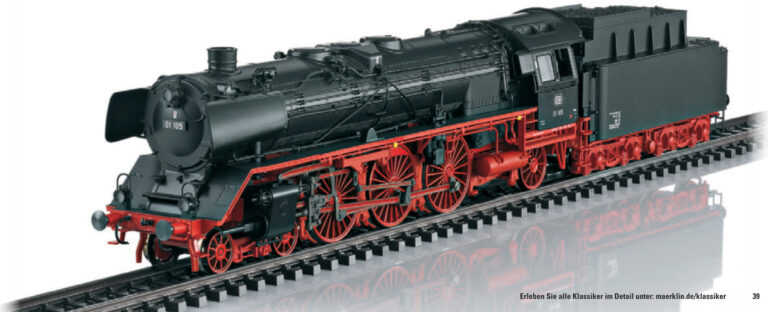
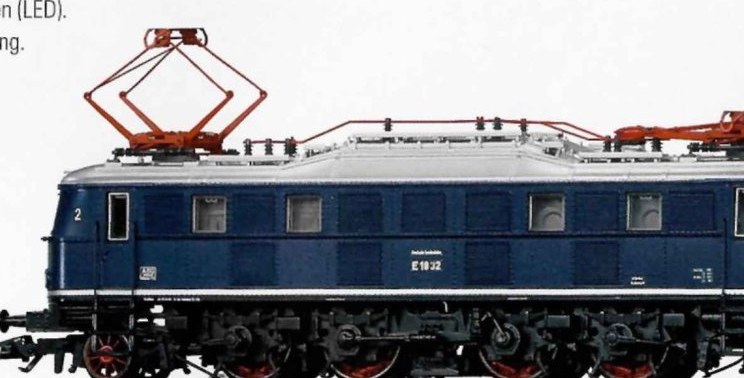
Typical on the model: the lettering “Deutsche Reichsbahn” or “DRG”, numbers in the Reichsbahn scheme (e.g. 01 105, E 18 01), steam locomotives black with red running gear, passenger cars bottle green, freight cars red-brown with a type-code city name (Gattungsbezirk) such as “Kassel” or “München”.
Well-known locomotives and trains of Era II
- Class 01 (from 1925): the first standard express locomotive, the epitome of the German steam locomotive – Märklin 39004 in the archive.
- Class 44 (from 1926): heavy three-cylinder freight locomotive, almost 2,000 built – Märklin 39745 in the archive.
- Electric locomotive E 44 (from 1932): the first Reichsbahn electric locomotive built in large numbers – Märklin 39441 in the archive.
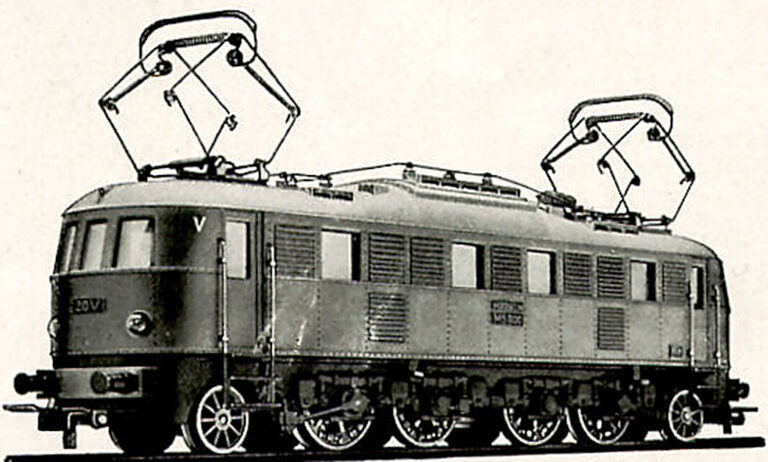
- Electric locomotive E 18 (from 1935): fast express electric locomotive, in service into the 1980s. Märklin built it in 00 gauge as early as 1949 – Märklin MS800 in the archive.
- “Flying Hamburger” SVT 877 (1933): diesel multiple-unit train Berlin–Hamburg, at the time one of the fastest scheduled train services in the world.
- Class 05 (1935): streamlined steam locomotive; in 1936 it was the first steam locomotive to exceed 200 km/h (124 mph) with a train.
- Rheingold (from 1928): luxury train from Holland to Switzerland with violet and cream cars.
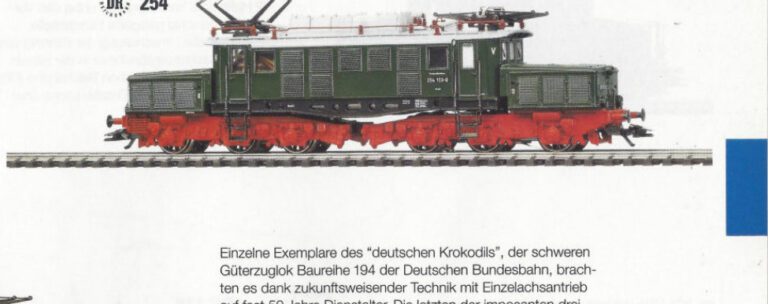
- “German Crocodile” E 94 (from 1940): heavy freight electric locomotive, also in Austria as class 1020 – Märklin 3722 in the archive.
- Wartime locomotive class 52 (from 1942): simply built, more than 6,000 made, later used by many European railways – Märklin 39532 in the archive.
Era II in Germany, Austria and Switzerland
NEM 806 D: from the founding of the Deutsche Reichsbahn in 1920 until shortly after the Second World War.
NEM 801 A / Austria
1920–1945: after the breakup of the Habsburg monarchy, the Austrian Federal Railways emerge by way of the D.Ö.St.B. and the Ö.St.B. The Südbahn and the NÖLB are taken over by the state. Expansion of electric train operation and development of railcars.
NEM 804 CH / Switzerland
1920–1945: electrification of most lines. Steam and electric operation side by side on the SBB.
More about Austria, Switzerland and the other countries: Railroad eras in Europe. What happened in Germany after 1949: Eras III and IV – Bundesbahn and Reichsbahn.